20 January 2026 · Falah Mousa
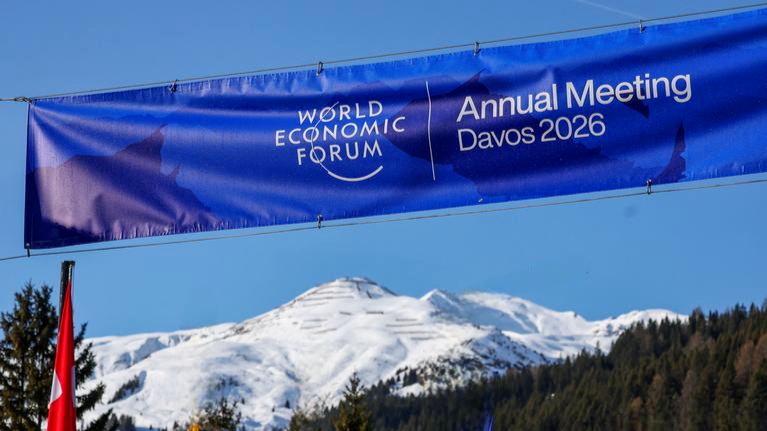
In the midst of the worst geopolitical tensions since the Second World War, and the deepest economic and technological divisions, the World Economic Forum is today holding its 56 th annual meeting in Davos (19-23 January), under the theme "The Spirit of Dialogue."
More than 3,000 participants from over 130 countries are attending this year's forum. It is the broadest edition in regards to political and economic representation since its inception in the 1970s. However, it also coincides with a "return of doubt" about the value of such large global events, and their capacity to really influence a world that is slowly getting, both politically and economically, divided and conflicted to an extent where even international principles and peace are being profaned, and where the rise of insular populist interests and the far right is leading to a progressive domination of the current global order.
According to forum's president and chief executive, Borge Brende "dialog in times of uncertainty is an urgency", and he considers this year's event to be among the most critical in Davos' history. But I want to point out that the 2026 Edelman Trust Barometer shows that: “grievance has devolved into insularity. Seven in 10 respondents report unwillingness or hesitance to trust someone with different values, approaches to social issues, backgrounds, or information sources. This insularity is highest in developed markets, including Japan (90 percent) and Germany (81 percent). It is also higher than the global average in the UK (76 percent) and Canada (73 percent), and on par with the global average in the U.S. (70 percent). Insularity cuts across income, gender, and age, and affects both developing and developed markets”. Therefore, WEF Interim co‑chair Larry Fink acknowledges the forum faces a crisis of legitimacy and urges participants to “listen to, not lecture” those affected by their decisions; he argues that prosperity must be judged by how many people can see it, touch it and build a future on it, not just by GDP or market caps.
All in all, although these criticisms give Davos sound reasons for questioning its effectiveness, it is still certainly among the few places where we can have direct access to face-to-face dialogue between heads of state, corporate giants and civil-society personalities. The significance of the forum in 2006 should be determined by the degree at which it can move beyond the elitist networking and bottomless rhetoric into producing real policy innovations and cooperation, while orienting itself to its gathermaking "betters the state of the world".
President Trump: Redrawing Geopolitical Balances:
In this tense, fractured context the USA President Donald trump will be heading to Davos leading the most numerous American delegation to the international forum. It can be viewed as a double-edged sword. On the one hand it will attract huge media, political attention. on the other it will underline the contradiction with the Davos message (partnerships, multilateralism, affirmation of openness) and that of President Trump (more isolationalism, more using pressure and threats, doubts that the foundations of the rules based international order, founded upon international agreements and international law, are sound). President Trump is expected to arrive with an agenda that is not just about trade, but also a broader attempt to redraw the geopolitical balances (from Ukraine and Gaza to Iran and Greenland.
Artificial intelligence that should be expected to hold a prominent seat to Davos 2026 and later is surely part of it. But it's not only about new technology and growth. Increasingly, AI becomes a fresh arena of competition among the great powers.
States now connect artificial intelligence to security interests, to global domination, and even to questions of war and peace. At the same time, governments are resorting to a greater range of economic and political instruments to coerce rivals, such as tariffs, curtailing of investments, sanctions, and state subsidies. This indicates that many of the principals designated to safeguard core international governance are destabilizing.
The plain truth being that the existing global order is not operating properly: when our trust in others is decreasing, we close the doors to each other's; hence, agreements and common rules disappear; even Leaders persisting in talking to each other's, transforming political uttering into deeds becomes a path filled with obstacles.
Support Our Work
If you find our content valuable, please consider supporting our mission through a donation. Your contribution helps us continue providing high-quality analysis and insights.
Donation Options:
If you enjoy my work and would like to support it while helping me stay energized, I’d be deeply grateful for a coffee.
https://buymeacoffee.com/falahmousa
Thank you sincerely for your kindness and consideration.
 Falah Mousa