16 July 2026 · Falah Mousa
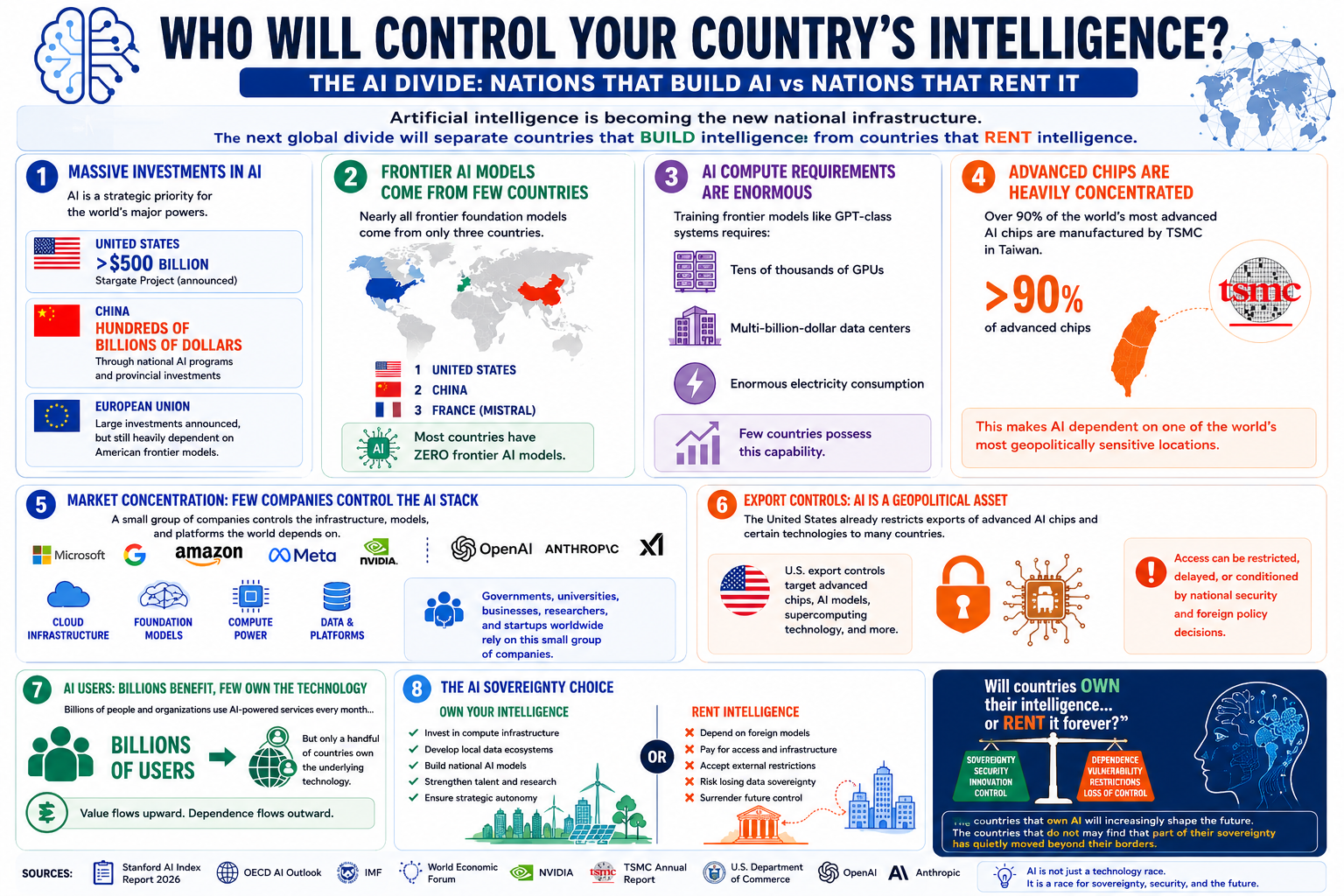
Artificial intelligence is no longer simply a technology story; it is becoming a sovereignty issue. Governments have discussed artificial intelligence for years in terms of its potential role within the digital economy. As such, it has been viewed as one of the many technologies which can enhance productivity, enable automation of cognitive functions, stimulate research and development, assist in improving decision making processes and create economic growth opportunities across all sectors.
However, this way of thinking about AI is rapidly being replaced by a growing recognition of its increasing status as a strategic resource. Like electricity, oil, satellite communications, ports, logistics for military supplies, cloud computing services and high-performance semiconductor devices, AI is becoming a key component of a nation's critical infrastructure. It is no longer just a tool which nations utilize. Instead, AI will increasingly influence how nations govern themselves. This is why recent American moves around access to advanced AI models should not be read only as a dispute between Washington and technology companies. They should be read as a signal from the future.
The US Government is starting to view the most cutting-edge forms of AI as national-security assets. Therefore, access to these types of AI models can be denied. In some cases, rollout of advanced AI model applications can be delayed. US Government can even establish formal vetting requirements for entities wishing to utilize advanced AI model capabilities. Additionally, access to certain advanced AI models can be limited for non-domestic users. Finally, in order to encourage cooperation between companies and the government, private companies utilizing advanced AI model capabilities may be required to work closely with the government. While the technical aspects of these actions may be described in terms of "safety", "cybersecurity", "export controls" or "responsible deployment", there is clearly a common thread running throughout them. The most capable AI systems will not continue to be regarded as neutral global public goods. Instead, they will be considered tools used to exert power.
Europe has heeded the warning. The debate today in Brussels, Paris, Berlin, and in all the major cities of Europe, is how to achieve technological sovereignty. European leaders are debating whether they should continue to build their economies; public administrations; research programs; security policies; and industrial development using foreign artificial intelligence (AI) systems which may become subject to restrictions by a foreign government. But it is not only about Europe; the challenge facing the Global South is much greater. Europe possesses money; universities; industry; customers for cloud computing; well-established institutions; and at least several AI companies with international ambitions. For many developing countries there is very little room to maneuver. Most developing countries rely heavily on foreign platforms for cloud services; operating systems; search engines; social media platforms; cybersecurity measures; e-commerce; and often even the national digital identities. These types of dependence will not diminish with the introduction of AI. Instead, they will be reinforced and deepened.
This represents a new type of dependency: dependency on foreign intelligence. This means not only dependency on foreign intelligence gathering agencies through traditional forms of espionage. However, it also includes dependency on foreign intelligence as applied to reasoning or thinking processes. The ability to read data; create algorithms; design policy; assess risk; coordinate logistics; support research; and make automated decisions are all examples of foreign intelligence. If a country depends solely on foreign suppliers for these capabilities, then it is not merely purchasing a service. In fact, it is effectively renting out a portion of its national consciousness to a foreign supplier. While this sounds extreme, it is an accurate way to describe what lies ahead.
A Ministry using foreign AI to create legislation is more than just adopting an entirely new digital tool. As much as it represents the adoption of a new digital tool, it also represents the beginning of dependency on the external infrastructure used to create public policy. That is true for other uses of foreign AI. Courts may use foreign AI to better organize their knowledge base; universities may use foreign AI to teach students; hospitals are increasingly turning to foreign AI for clinical support; and news organizations will likely become increasingly reliant upon foreign AI to develop and distribute content. Each example illustrates how part of a nation's capacity to think, organize information, and make decisions will eventually be transferred outside of its institutions.
Initially, there will obviously be advantages to utilizing foreign AI. Nations will be able to supplement their lack of trained personnel by hiring companies that utilize foreign AI systems; companies will have access to expertise they could never afford to hire; schools and hospitals will be able to accomplish more with fewer resources. Foreign AI will provide capabilities to most developing nations which would be unattainable without these tools. Again, this is not necessarily anything wrong with this. The issue occurs when reliance on foreign AI transitions from being convenient to being dependent. Efficiency does not equal sovereignty.
International AI technology will definitely bring advantages. Countries short of training for workers can buy foreign technology to supplement that shortage; Companies will be able to tap into expertise that would otherwise be out of reach; Schools and hospitals will be able to accomplish more with fewer resources. Countries that lack means to acquire certain capabilities otherwise will get access to capabilities through international AI technology. This is not inherently wrong. Problems arise though when a country becomes overly dependent on that international AI. Therefore, the real question is not whether countries should use foreign AI. They almost certainly will and in many cases should use it. What is much more important is whether they will have meaningful alternatives if access is restricted, prices go up, regulations change or political decisions determine who can use that technology. If they don't have alternatives, they could lose access to AI, cloud services and digital infrastructure on which much government, economy, businesses, universities and public services rely.
This is one of the reasons for AI "kill switches" to exist. It doesn't have to be sensational. It could occur in many forms; a new license agreement, a higher price tag, an additional regulatory requirement, a new sanctions designation, a new export control rule, a cloud services review, downgrading models for certain use cases, refusing service to specific customers, or simply deciding certain markets are now too high-risk. On any given day a nations’, universities’, companies', journalists', ministries', and banks' reliance upon AI tools can suddenly stop working due to changes in how those tools will be made available. That is not a minor technical issue. It is a major strategic vulnerability.
Major world powers have already chosen a path for themselves. The U.S. has decided to be the world's leading country in developing Artificial Intelligence. China has begun to invest a great deal of money into developing new technologies so it can become less dependent on U.S. based technology. Europe is working hard at creating technological independence. Many other nations such as India and those of the Gulf region are developing AI capabilities that help them achieve their own economic development and strategic goals. The AI race is already underway. For the Global South, the challenge is not to compete with the United States or China, but to avoid being left with no meaningful technological capacity of its own.
The majority of developing countries today are also viewing AI as merely just one additional tool which they can purchase from overseas. While purchasing AI from other nations could quickly give them access to many potentially valuable tools, it would not build their ability to utilize these tools without external support. The higher the dependence of such organizations (i.e., government, business, university, hospital, banking system, etc.) on AI based tools there will be an increasing amount of costs associated with them not having the capability to develop this technology internally. Developing some level of control over how they use AI has become a fundamental need for the Global South in order to promote economic growth, enhance public administration, improve national security, and encourage technological self-reliance.
One of the major obstacles for many countries is the creation of a solid foundation (infrastructure) to support advanced artificial intelligence. For advanced artificial intelligence to operate at its full potential, it requires both dependable power (electricity), cutting-edge data canters, high performance computers, fast connectivity via internet (broadband networks), and well-trained/educated professionals with technical skills. At this time, most developing countries do not have sufficient reliable power, cost-effective internet service availability and/or the necessary modern digital infrastructure to create frontier class artificial intelligence. Developing countries may wish to consider focusing on creating their own areas of expertise in their respective countries as opposed to building large-scale frontier artificial intelligence; developing specialized models to meet specific needs in their country; increasing investment into digital infrastructure such as data storage facilities, telecommunications and computer networking; and fostering collaboration with neighbouring countries in order to share computing resources, research capacity and technical knowledge.
Regional collaboration could well be one of the biggest opportunities for Global South nations. Developing countries individually have limited capabilities to create global-level AI ecosystems, however as a group they present huge market potential, rich diversity in data sets, rapidly expanding digital economies, and substantial human resources. They can share research canters, regional computing platforms, make common investments in digital infrastructure, and collaborate in developing language-based models. This will provide them with reduced cost levels while achieving greater technological autonomy. Additionally, by working together they will be able to enhance their bargaining power in negotiations with the major technology firms of the world. At the same time, countries should avoid becoming dependent on any single technology provider. An effective AI strategy should remain flexible. Governments should use the best available technologies while continuing to invest in domestic skills, universities, research institutions, and local technology companies. Protecting strategic data, encouraging open standards, and developing local expertise are likely to prove more valuable over the long term than relying entirely on imported systems, regardless of where they originate.
AI has become a component of global critical infrastructure and nearly all countries will apply it in some way. The real division won't exist between countries adopting AI and countries which don’t; however, the division will occur between the countries building the institutional base (knowledge, skills) required for creating an environment where AI is created and applied to support their local society needs, as opposed to those that are dependent upon other countries developing the systems used to create AI.
For the Global South, the issue isn't competing with the world's top AI powers by replicating Silicon Valley, it's building enough capability so that AI supports its own languages, economy, institutions and developmental priorities instead of being a long-term dependency.
Support Our Work
If you find our content valuable, please consider supporting our mission through a donation. Your contribution helps us continue providing high-quality analysis and insights.
Donation Options:
If you enjoy my work and would like to support it while helping me stay energized, I’d be deeply grateful for a coffee.
https://buymeacoffee.com/falahmousa
Thank you sincerely for your kindness and consideration.
 Falah Mousa