30 July 2026 · Falah Mousa
Ravenous fires. Searing heat waves. Freakish storms. The summer of 2026 has already shattered meteorological records in several European countries. On a continent that has endured centuries of upheaval, including ruinous wars and deadly pandemics, it is now the weather that has Europe feeling close to a breaking point.
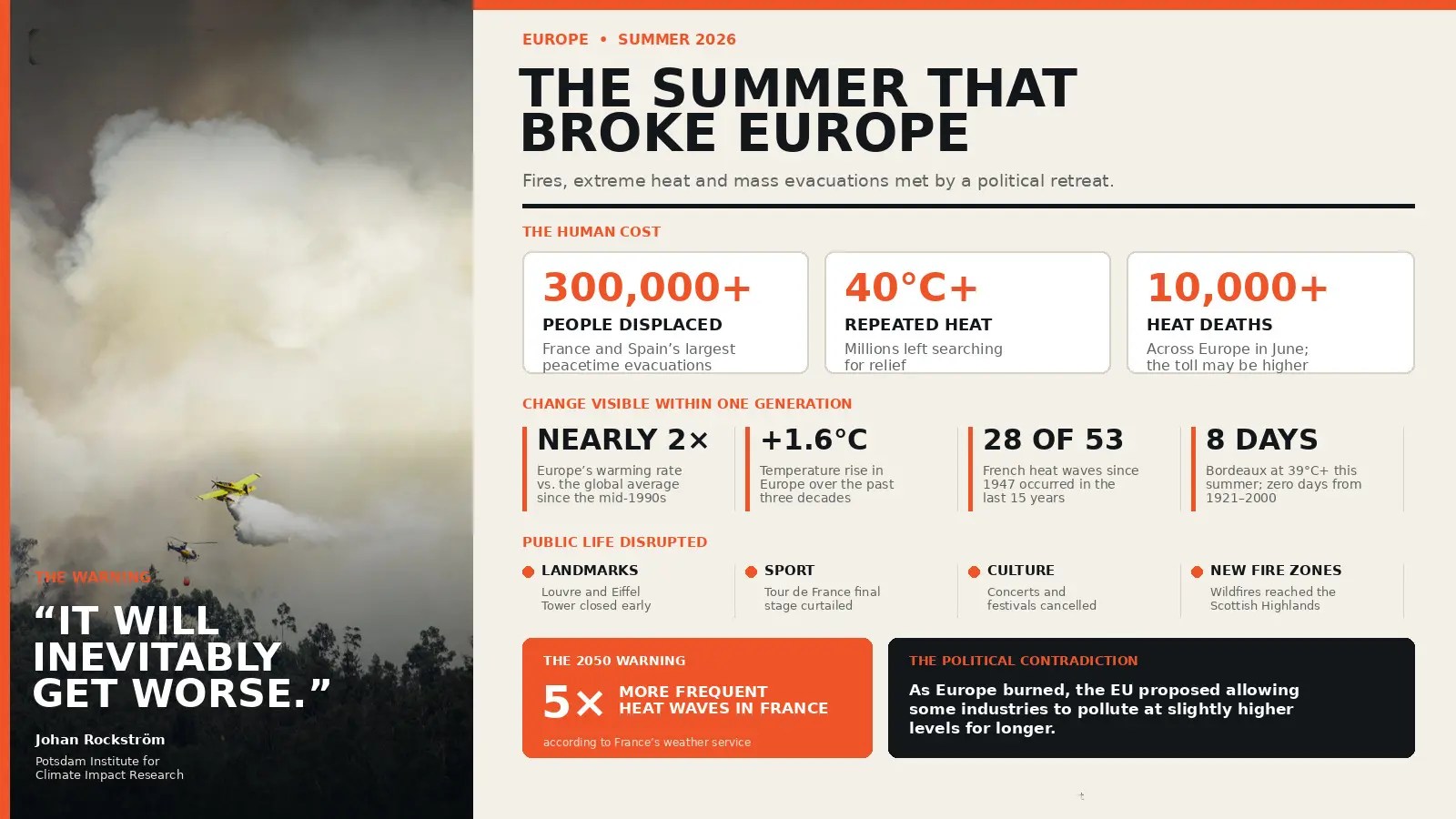
More than 300,000 people have been displaced in France and Spain. The largest fires in the modern histories of both countries have led to their largest peacetime evacuations. Millions of Europeans have been left desperate for relief as temperatures repeatedly rise above 40 degrees Celsius.
The heat has forced the cancellation of concerts and festivals, curtailed the final stage of the Tour de France, and led the Louvre Museum and the Eiffel Tower to close early. Wildfires have even reached the Scottish Highlands. Across Europe, at least 10,000 heat-related deaths were recorded in June alone, and the real number may be higher.
The most frightening part of Europe’s terrible summer is that scientists believe this is only the beginning.
“It will inevitably get worse,” warned Johan Rockström, a Swedish scientist and director of the Potsdam Institute for Climate Impact Research in Germany. “It will get worse and worse and worse, to the point where, I’m afraid, we’ll be passing the limits of adaptation.”
Europe is not alone. Heat waves have affected Australia and Japan. Floods have devastated Kenya and Angola. A snowstorm paralysed parts of the eastern United States. Developing countries in the Southern Hemisphere remain more vulnerable than wealthy European countries to the effects of a changing climate.
Yet no other continent is warming as rapidly as Europe. Since the mid-1990s, it has been heating at nearly twice the global average.
This is partly the result of changing weather patterns and partly because of Europe’s proximity to the Arctic. As Arctic snow and ice disappear, they expose darker surfaces that absorb more heat instead of reflecting it.
Europe is now more than 1.6 degrees Celsius warmer than it was three decades ago. The change is happening quickly enough to be noticed within a single generation. France has recorded 53 heat waves since 1947, but 28 of them occurred during the past 15 years.
The figures from Bordeaux show how sharply conditions are changing. Between 1921 and 2000, the city never experienced a day with temperatures at or above 39 degrees Celsius. This summer, it has already happened eight times, even though the season is not yet halfway over. Bordeaux is now also being threatened by wildfire.
Europe may still be cooler than many other parts of the world, but it is poorly prepared for extreme heat. Many buildings lack air-conditioning and were designed to retain warmth. Forests and coastal areas are often covered by the same types of trees, making them dangerously vulnerable when heat and drought create the conditions for large fires.
Europeans are being forced to confront the reality of a changed climate more directly than before. The question is whether governments will respond with measures serious enough to reduce future warming and protect people from conditions that can no longer be avoided.
Spain’s prime minister, Pedro Sánchez, has declared a “climate emergency” and called for a state pact to address the problem structurally. In France, President Emmanuel Macron has promised to replant the pine forests destroyed by fire in the Gironde region with different tree species that are better suited to a hotter and drier climate.
“The situation we’re in today is the most difficult we’ve ever recorded, the most difficult since World War II,” Macron said.
But there is a clear contradiction between the urgency of these warnings and Europe’s political direction. While fires spread and temperatures rise, the European Union is considering changes that would allow some industries to continue polluting at slightly higher levels for longer.
Net-zero policies, which aim to balance the greenhouse gases released into the atmosphere with those removed, have become political targets. Critics, particularly on the right, describe them as a luxury Europe cannot afford during a period of weak economic growth and energy insecurity.
Yet the climate crisis does not disappear because cutting emissions is politically or economically difficult. Europe is already paying through evacuations, deaths, destroyed forests, disrupted public events and communities placed under constant threat.
Europe cannot determine the global climate outcome by itself. Much depends on China, the United States and energy-hungry developing countries. The American president has even dismissed climate change as a “con job.” But dependence on the actions of other countries does not remove Europe’s responsibility to reduce its own emissions and prepare its societies for what is coming.
The planet is already on course to miss the central target of the 2015 Paris Agreement: keeping global warming well below two degrees Celsius above preindustrial levels. France’s national weather and climate service has warned that heat waves could become five times more frequent by 2050.
The past few months may be remembered as the summer that broke Europe. The greater danger is that, when Europeans look back from the middle of the century, the summer of 2026 may seem relatively mild.
#ClimateCrisis #EuropeHeatwave #ExtremeHeat #Wildfires #Europe2026
 Falah Mousa