Falah Mousa
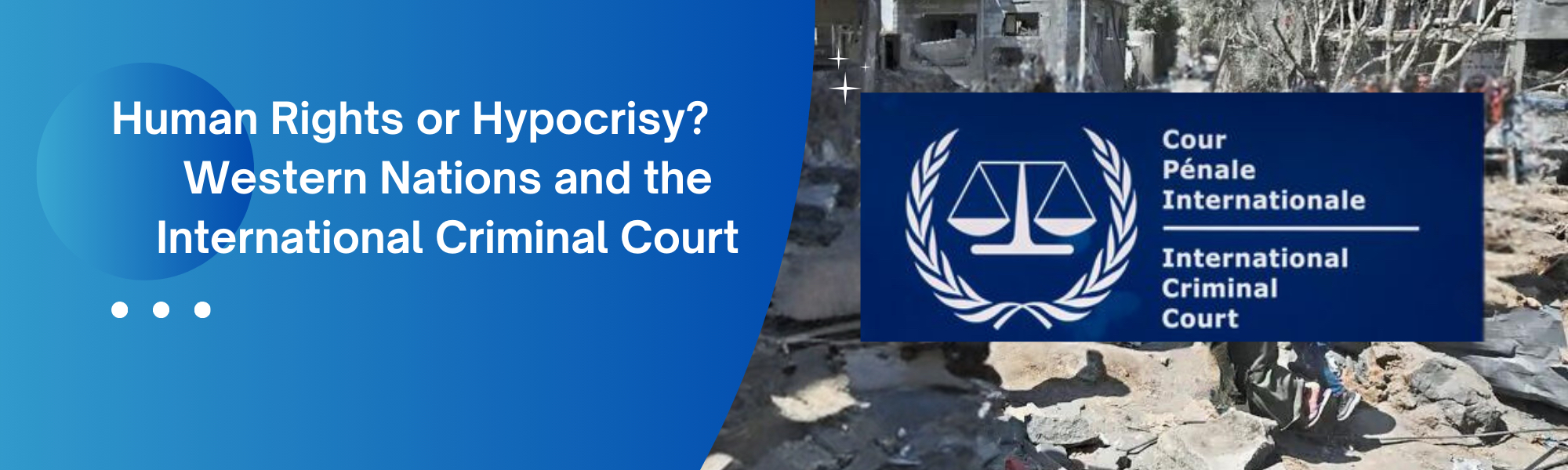
International Justice Day, observed annually on July 17, commemorates the historic adoption of the “Rome Statute” in 1998. This significant day emphasizes the ongoing fight against impunity and the pursuit of justice for victims of war crimes, crimes against humanity, and genocide. Amid the complex landscape of international law, Western nations, including the United States, often advocate for human rights and democratic values. However, their intricate relationship with the International Criminal Court (ICC) reveals challenges in applying universal justice principles, exposing contradictions in Western foreign policies. The selective support for the ICC by these nations often aligns with their strategic interests, revealing a pattern where human rights are used as tools of diplomacy rather than universal imperatives. This approach undermines the credibility of international institutions and erodes trust in impartial justice, suggesting that adherence to international law is often a strategic choice rather than a principled stance. The ambivalence of powerful nations towards the ICC, highlighted by coercive tactics and political interference, limits the court's independence and threatens to reduce it to a pawn in international power politics. As the world grapples with these complexities, the unwavering support of ICC member countries for the court’s independence offers a glimmer of hope for a more just and equitable international system.
Balancing Human Rights Advocacy:
Human rights are designed to be universal, ensuring that every individual, regardless of their background, is afforded certain fundamental protections. The United States has historically been a vocal proponent of these principles. Yet, its engagement with the ICC reveals a selective approach that reflects broader geopolitical realities. For instance, while the U.S. strongly supports the ICC’s efforts to address war crimes in Ukraine and Darfur, its stance shifts when investigations pertain to actions involving Israel, a key ally. This shift can be attributed to the inherent "us-versus-them" mentality that influences global politics. It is easier to empathize with those who share our values and identity, and this empathy often diminishes when considering those who are different or adversarial. In conflict situations, this bias can lead to the dehumanization of opponents, making it challenging to uphold their rights.
However, this selective approach to human rights advocacy goes beyond mere bias. It raises critical questions about the authenticity of the U.S.'s commitment to universal principles. Is the U.S. genuinely committed to human rights for all, or are these principles invoked selectively to serve strategic interests? When the U.S. condemns human rights abuses in adversarial states but turns a blind eye to similar actions by its allies, it risks undermining the very foundation of international human rights norms.
Furthermore, this selective engagement with the ICC can be seen as a form of geopolitical manipulation. By supporting the court's actions in certain contexts and obstructing it in others, the U.S. leverages international justice as a tool of foreign policy. This approach not only weakens the credibility of the ICC but also erodes trust in the international legal system. It sends a message that justice is not a universal right, but a privilege granted at the discretion of powerful states. The implications of this stance are far-reaching. It fosters a world where power dynamics dictate the application of justice, undermining the principle of equality before the law. For countries observing these double standards, the message is clear: alliances and political considerations can shield perpetrators from accountability. This reality can embolden states to commit abuses with impunity, knowing that their geopolitical value may offer them protection from international scrutiny.
The United States, though not a member of the ICC, has engaged with the court in various capacities over the years, with the Biden administration recognizing its role in prosecuting war crimes in certain regions. However, the U.S. response to ICC actions involving Israel, such as ICC prosecutor Karim Khan's announcement of arrest warrants for individuals from both Hamas and the Israeli government, led to significant political reactions, including threats of sanctions from twelve U.S. senators and a bill passed by the House of Representatives aimed at sanctioning the ICC and its supporters. The ICC’s independence is also under threat from other quarters. For example, in 2023, Russian authorities issued arrest warrants for Khan and six judges following the court's issuance of warrants for President Putin and another official for war crimes in Ukraine. This move was accompanied by laws criminalizing cooperation with the ICC. Despite these pressures, ICC officials continue to fulfill their mandate, reflecting their commitment to justice in both the Palestine and Ukraine investigations, with unified support from ICC members underscoring their resolve to defend the court’s independence and impartiality.
Global Support for the ICC
Despite these challenges, the ICC enjoys robust international support. Ninety-three member countries have pledged their unwavering commitment to the court, emphasizing its essential role as an independent and impartial institution. This collective stance is crucial in countering political pressures and ensuring the ICC can function without interference.
In a joint statement, these countries underscored the importance of upholding the principles and values of the Rome Statute and protecting its integrity from any form of interference and pressure. They also called on all nations to ensure full cooperation with the ICC.
The endorsing countries include Australia, Canada, the UK, Japan, Bosnia and Herzegovina, Malta, Mauritius, Mexico, Mongolia, Montenegro, Namibia, Germany, and France, along with Belgium, Jordan, South Africa, Spain, Sweden, Switzerland, Chile, Colombia, Senegal, and Slovenia, among others. “As States Parties to the Rome Statute of the International Criminal Court, we uphold that the Court, its officials, and staff shall carry out their professional duties as international civil servants without intimidation,” the statement read. “The ICC, as the world’s first and only permanent international criminal court, is an essential component of the international peace and security architecture,” it added. “We therefore call on all States to ensure full cooperation with the Court for it to carry out its important mandate of ensuring equal justice for all victims of genocide, war crimes, crimes against humanity, and the crime of aggression, grave crimes that threaten the peace, security, and well-being of the world.” (See the official Government of Canada website: canada.ca. See also Belgium UN New York, at x.com).
This international solidarity is a powerful counterweight to efforts aimed at undermining the court's independence. It signals a steadfast commitment to upholding universal principles of justice, even when politically inconvenient. The global community's support for the ICC is a testament to the enduring belief in the rule of law and the pursuit of justice for all, regardless of political affiliations.
A Path Forward: Consistent Application of Justice:
It is our responsibility to advocate for a world where justice is guided by consistent principles rather than political expediency. Only through a commitment to impartial justice can we hope to build a truly equitable international order. The challenges we face are profound, but they are not insurmountable.
The quest for justice in this intricate and often contentious landscape demands not only the courage to hold all perpetrators accountable but also the resolve to uphold the principles of universality and impartiality. The credibility of international law hinges on its consistent application. When justice is applied selectively, it erodes trust in legal institutions and diminishes the moral authority of those who advocate human rights.
The U.S., like other powerful nations, faces a crucial choice: to continue wielding international justice as a diplomatic instrument or to embrace a genuinely principled approach that upholds the integrity of global human rights. The path it chooses will significantly influence the future of international law and the quest for a truly just world order.
Support Our Work
If you find our content valuable, please consider supporting our mission through a donation. Your contribution helps us continue providing high-quality analysis and insights.
Donation Options:
PayPal: falahmousa@gmail.com
Scan PayPal Payment:

Bank Transfer:
IBAN: BE33967579583046
SWIFT/BIC: TRWIBEB1XXX
Bank Name and Address: Wise, Rue du Trône 100, 3rd floor, Brussels, 1050, Belgium
Contact: fm@falahmousa.com
 Falah Mousa