Falah Mousa
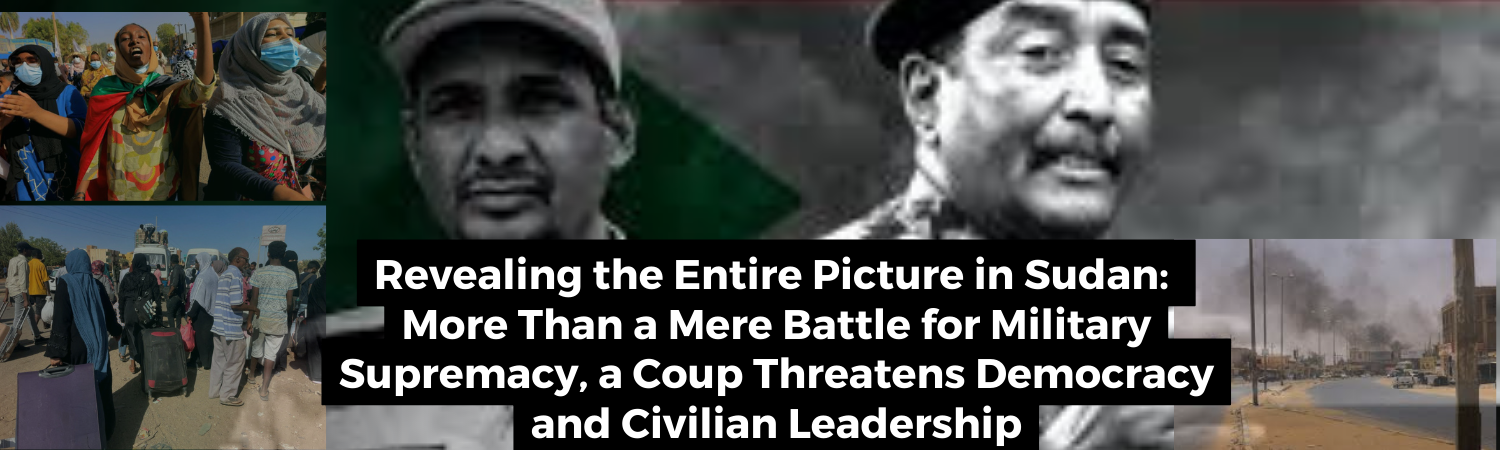
Since attaining independence in 1956, Sudan has been plagued by 35 coups, coup attempts, and coup plots, surpassing any other African nation (statista.com). In 2019, an uprising against the long-time dictator Omar al-Bashir led to the formation of a military-civilian transitional government, fuelling hope for a future transition to civilian democratic rule. However, in October 2021, these aspirations were crushed as Abdel Fattah al-Burhan coup against the transitional government's civilian members. Now, al-Burhan and the Sudanese Armed Forces (SAF) are locked in a fierce conflict with General Mohamed Hamdan Dagalo, the leader of the notorious Rapid Support Forces (RSF). This battle threatens to entirely derail the Transition Plan and indefinitely delay the transfer of power to civilian hands. Four months following the ousting of Bashir on April 11, 2019, the military signed a constitutional declaration with the principal civilian coalition, the Forces of Freedom and Change. This agreement paved the way for a joint military-civilian transitional government. To dismantle the intricate web of parastatal charities, media enterprises, and banks that had facilitated Bashir and his Islamist allies' stronghold over Sudan, the transitional government created an Empowerment Removal Committee. However, in October 2021, Burhan's troops side-lined the committee and arrested most of its prominent members.
The coup happened following months of escalating tensions between the military and civilian government. Discontented with the pace of the democratic transition, the military accused the civilian government of corruption and incompetence. On the day of the coup, the military detained numerous high-ranking civilian government officials, including Prime Minister Abdalla Hamdok, and dissolved the Sovereignty Council, which had been supervising the shift to democracy. This development ignited widespread demonstrations throughout Sudan, as thousands of citizens marched to demand the reinstatement of the civilian government. The military responded with a brutal repression on the protestors, leading to the deaths of dozens of individuals.
Power Play: An Intricate Coup Endangering Democracy and Civilian Leadership
Earlier in April 2023, Sudan's political parties, armed forces, and civil society were on the brink of signing a new political agreement and establishing a new civilian government. The Sudan Armed Forces (SAF) and Rapid Support Forces (RSF) were anticipated to be part of an accord, set to be negotiated between military actors and other civilian entities, encompassing political parties, and civil society that had endorsed the Political Framework Agreement. This final political agreement, planned for signing in April, aimed to initiate or reinstate Sudan's democratic transition. However, just days before the signing, on April 15, the Sudanese unexpectedly witnessed conflict erupt between the SAF and RSF.
The alliance between the SAF and RSF was primarily a matter of convenience. Their collaboration allowed them to consolidate power against civilian factions, safeguard their economic interests, and shield themselves from potential prosecution for past human rights abuses. Throughout Sudan's transition, their partnership remained intact, with both factions playing a role in orchestrating the power grab. However, since the coup, the rift between the two leaders has widened as they each attempt to advance their own agendas and covertly negotiate with civilian parties, particularly on matters concerning foreign relations and security issues.
Simultaneously, the Islamists, who were affiliated with the previous Bashir regime, seized every opportunity to exploit the discord between the Sudanese military forces and the civilian coalition, the Forces of Freedom and Change. They anticipated that the violence and upheaval would provide a chance for their resurgence and return to power. Islamist leaders made statements just days before the hostilities commenced, proclaiming that chaos would engulf Khartoum and Sudan, and they would emerge as the saviours. These leaders sought to hasten the deterioration of the relationship between both generals, hoping it would escalate into an all-out war.
The Radical Islamist Coalition and the Army in Sudan
In relation to the above mentioned, the army is perceived by many as the final bastion of the old regime, which was heavily influenced by Islamists during Omar al-Bashir's rule. In fact, allegiance to the Islamists was frequently a prerequisite for entry into the Military College during that period. From the Islamist perspective, Lieutenant General Hemeti is considered a turncoat who, rather than defending their regime, sided with the revolutionaries. The presence of the RSF forces has effectively diminished the army's clout. This is why the army is so insistent on incorporating these forces into its ranks as a means of exerting control, instead of allowing them to function as an autonomous entity. Therefore, the leadership of the RSF has a well-defined strategy for assimilating its troops into the Sudanese military, encapsulated in the phrase "reform before integration." The RSF's top brass contends that the army, which was tainted by three decades of Islamist domination and sway, must undergo reform prior to any unification efforts. The RSF's chief has consistently asserted that he will not combine his forces with an 'Islamist' military.
The Military Conflict in Sudan Targets the Transition Plan and Resists Handing Over Power to Civilians
It is crucial to understand that the political agreement slated for signing in April 2023, which aimed to establish a new civilian government, intended to grant civilians a significant increase in political and executive power while reducing the military's influence over political and economic activities. However, the efforts to re-establish the democratic transition were halted when the army took control on October 25, 2021. Before signing the agreement, and during this critical phase of the political process, the army sought to advance its own agenda by covertly negotiating with civilian parties—particularly on matters concerning foreign relations and security issues. Furthermore, the army aimed to curtail the sway of the RSF, led by the Vice-President of the Sovereign Council, Lieutenant General Mohamed Hamdan Dagalo (also known as Hemeti), and restrict their future role in Sudan.
Although the leadership of both the army and the RSF have publicly pledged to step back from politics and transfer power to civilians, fulfilling this promise has proven challenging. Both entities have sought to expand their influence beyond the realms of security and defence. Consequently, the military forces have exerted pressure on the civilian government to acknowledge their de facto presence within the executive branch and to cede control over specific domains. This would enable the army to preserve the foreign relations they have cultivated since assuming power in October 2021.
In summary, Burhan's and Hemeti's apprehension regarding civilian efforts to curtail military privileges has influenced their actions. On one hand, they have chosen to maintain critical components of the Bashir system. On the other hand, they have incited discord between themselves and fostered instability, rather than supporting the political transition. This situation has now evolved into a high stake "game of chicken," pushing the country to the brink. Meanwhile the international community must glean lessons from their past errors in placing faith in the generals. Merely appealing to the Sudan Armed Forces and the Rapid Support Forces with gentle rhetoric and modest entreaties will not suffice. It is high time for the global community to recognize that both military organizations have consistently and unabashedly engaged in deception since 2019. As such, they should not be trusted in any forthcoming political process, should it occur, and they must be held responsible for their actions.
© Falah Mousa 2024
Support Our Work
If you find our content valuable, please consider supporting our mission through a donation. Your contribution helps us continue providing high-quality analysis and insights.
Donation Options:
PayPal: falahmousa@gmail.com

Scan PayPal Payment:
Bank Transfer:
IBAN: BE33967579583046
SWIFT/BIC: TRWIBEB1XXX
Bank Name and Address: Wise, Rue du Trône 100, 3rd floor, Brussels, 1050, Belgium
Contact: fm@falahmousa.com
 Falah Mousa