Falah Mousa
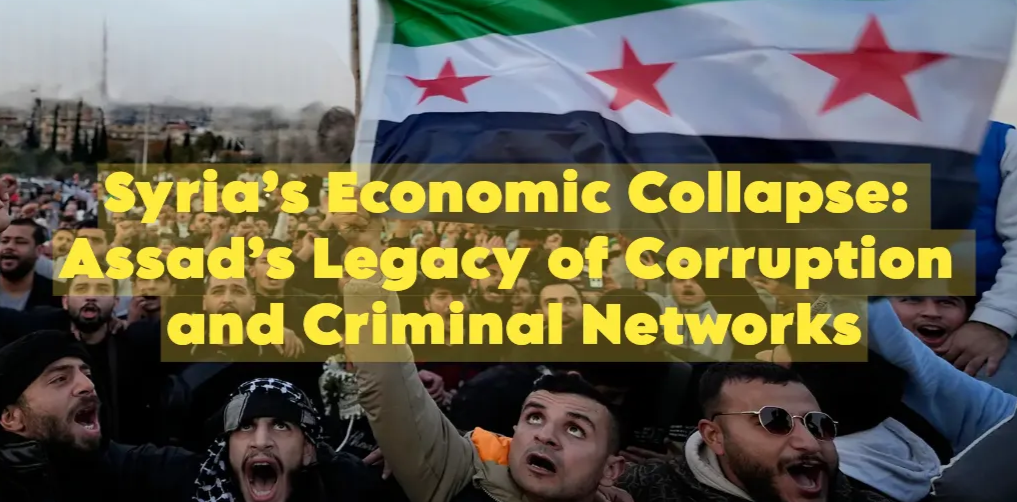
Having fled to Moscow, Bashar al-Assad leaves behind a Syria economically and morally bankrupt, a nation ravaged by 13 years of civil war, authoritarian mismanagement, and systemic corruption. Once a relatively prosperous country, Syria is now a shattered economy, sustained more by illicit activities than legitimate enterprise. The nation’s gross domestic product (GDP), which stood at $68 billion in 2011 when protests against Assad’s regime began, has since plunged to an estimated $6.2 billion in 2024, according to the World Bank (data.worldbank Syrian Arab Republic). This figure excludes the flourishing black market, which has become a primary driver of economic activity in the absence of functioning institutions.
The collapse of Syria’s economy is unparalleled, exacerbated by Western sanctions, particularly the United States’ Caesar Act, which has severely restricted international financial transactions and trade. Yet, rather than reforming or seeking genuine recovery, the Assad regime entrenched its hold on key sectors, transforming the economy into a tool of patronage for its inner circle. Corruption has metastasized, with international watchdogs repeatedly documenting the regime’s criminal entanglements. Among the most striking examples is the Captagon trade, a booming synthetic drug industry estimated to generate between $2 billion and $5 billion annually, which has become a cornerstone of the regime's finances. Smuggling, human trafficking, and the looting of antiquities have further supplemented state revenues, providing a lifeline to a regime otherwise isolated on the global stage.
The economic devastation is vividly reflected in the Syrian lira’s collapse. In 2010, the currency traded at 46 SYP/USD; today, it hovers around 14,500–15,500 SYP/USD in Damascus, while regions like Idlib have abandoned it altogether, using Turkish lira instead. This monetary disintegration reflects the broader fragmentation of the national economy. Foreign currency reserves have plummeted from $20 billion in 2010 to an estimated $700 million by 2016, with no official updates since. Analysts suspect that billions have been siphoned off by the Assad family, hidden in Russian accounts and offshore havens. The resulting hyperinflation has been devastating cumulative inflation over the conflict years exceeds 2,000 percent, with annual rates expected to reach 100 percent in 2024. Ordinary Syrians have borne the brunt of this economic collapse, with civil servants now earning an average of just $30 per month. Inflation has pushed the poverty rate to an estimated 69 percent in 2022, a figure that has likely worsened.
Syria’s economic pillars, once central to its prosperity, lie in ruins. Oil production, which contributed 30–35 percent of GDP before the war, has shrivelled from 385,000 barrels per day in 2011 to a mere 25,000–40,000 barrels per day today. Many of the country’s oil fields were under the control of Kurdish forces or other factions, which prevented the regime from accessing this once vital source of revenue. Agriculture, which accounted for 20–25 percent of GDP, has been similarly crippled. Once a source of self-sufficiency, the sector has been decimated by forced migration, internal displacement, drought, and the destruction of irrigation infrastructure. Wheat and cotton production, formerly national staples, are now drastically diminished compared to their previous levels.
Industry and trade have fared no better. The textile sector, once a leading contributor to Syria’s industrial base, has collapsed. Exports, which totalled $12 billion in 2010, have fallen to just $1 billion in 2024, a stark indicator of the country’s economic isolation. Tourism, too, has evaporated. Once accounting for 12 percent of GDP and drawing nearly eight million visitors annually, the industry has been obliterated by the destruction of cultural landmarks and the ongoing instability.
The Road to Rebuilding Syria: Concrete Challenges and a Path to Recovery
Syria’s road to recovery is arduous but not insurmountable. To approach pre-2011 levels of domestic production, the country requires more than just political stability and reconstruction funding—it demands a comprehensive overhaul of its governance and economic systems. The World Bank has estimated that restoring Syria’s GDP could take over a decade of sustained growth, but such projections hinge on dismantling the entrenched corruption, monopolies, and illicit networks that have thrived under Bashar al-Assad’s regime. With Assad now in exile in Moscow, a unique window for transformation exists, but progress will require bold, systematic action from the new leadership and strong international support.
The new government, led by Prime Minister Mohammed al-Bashir, must prioritize pragmatic, impactful reforms rather than symbolic gestures. Rebuilding Syria’s shattered economy necessitates immediate steps, such as securing foreign aid for large-scale infrastructure projects and incentivizing private investment to revitalize key sectors like agriculture and manufacturing. Targeting corruption must be at the forefront: establishing an independent anti-corruption commission with international oversight could dismantle the deep-seated networks that continue to stifle economic progress.
Reopening vital trade corridors, including the Nasib border crossing with Jordan, is crucial to restoring commerce and easing food shortages. Yet, trade on its own will not suffice. A long-term recovery plan must include re-establishing agricultural production through investment in irrigation systems, seed distribution, and subsidies for displaced farmers. Additionally, stabilizing the Syrian pound will require not only central bank reforms but also measures to rebuild public trust in the currency, such as transparent fiscal policies and reducing reliance on black-market economies.
A critical component of Syria’s recovery is addressing the humanitarian crisis. The return of the 6.4 million Syrian refugees cannot merely be encouraged through rhetoric. The government must ensure conditions for their safe and dignified repatriation by rebuilding housing, schools, and healthcare facilities. Beyond physical infrastructure, fostering social cohesion and rebuilding trust among Syria’s fractured communities is essential. Offering amnesties to certain factions while ensuring accountability for war crimes could strike a delicate balance between justice and reconciliation.
Internationally, Syria’s recovery hinges on recalibrating its foreign relations. Assad’s reliance on Russia and Iran left the country politically dependent and economically exploited. Al-Bashir administration should seek to engage Gulf states and Turkey to secure reconstruction funding and encourage regional investments, while demonstrating to Western powers a genuine commitment to economic transparency and human rights. As well as stopping drug smuggling and addressing migration pressures, which could unlock further financial and diplomatic support.
Despite these opportunities, the challenges are immense. Corruption remains deeply embedded in Syria’s bureaucracy, and remnants of Assad’s networks continue to operate in shadow economies. Furthermore, the HTS-led coalition’s questionable human rights record and Islamist underpinnings raise concerns about whether the new leadership will genuinely embrace pluralism and democracy. To address these risks, the al-Bashir government must commit to reforms that are visible and verifiable, like engaging international monitors, reforming the judiciary, and empowering civil society to participate in governance.
The geopolitical consequences of the fall of Assad’s regime present both risks and opportunities. Russia, facing setbacks in Ukraine and diminished influence in Syria, is recalibrating its regional strategy, while Iran, deprived of a key ally, finds itself more isolated than ever. This shifting landscape could allow Syria’s new government to revise and redefine its foreign alliances and dependencies. By rebalancing its relationships, Syria could position itself as a neutral player in the region, attracting broader international support.
In conclusion, Syria’s future depends on bold leadership, innovative policy reforms, and strategic international partnerships. The collapse of Assad’s regime has created a rare moment of possibility; but capitalizing on it requires addressing Syria’s corruption-riddled foundations and creating an inclusive vision for the nation’s recovery. Success will not come easily, but with decisive action, Syria can transition from a war-torn state to a nation poised for stability and growth.
For the millions of Syrians displaced, impoverished, or left to face the challenges of survival, and those who have recently been freed from Assad’s prisons and those still trapped in fear and confusion about the current chaos and the uncertain future, the question remains whether the international community will act, or whether Syria will remain indefinitely trapped in the destruction left by al- Assad and the fall of his brutal regime.
Support Our Work
If you find our content valuable, please consider supporting our mission through a donation. Your contribution helps us continue providing high-quality analysis and insights.
Donation Options:
PayPal: falahmousa@gmail.com
Scan PayPal Payment:

Bank Transfer:
IBAN: BE33967579583046
SWIFT/BIC: TRWIBEB1XXX
Bank Name and Address: Wise, Rue du Trône 100, 3rd floor, Brussels, 1050, Belgium
Contact: fm@falahmousa.com
 Falah Mousa