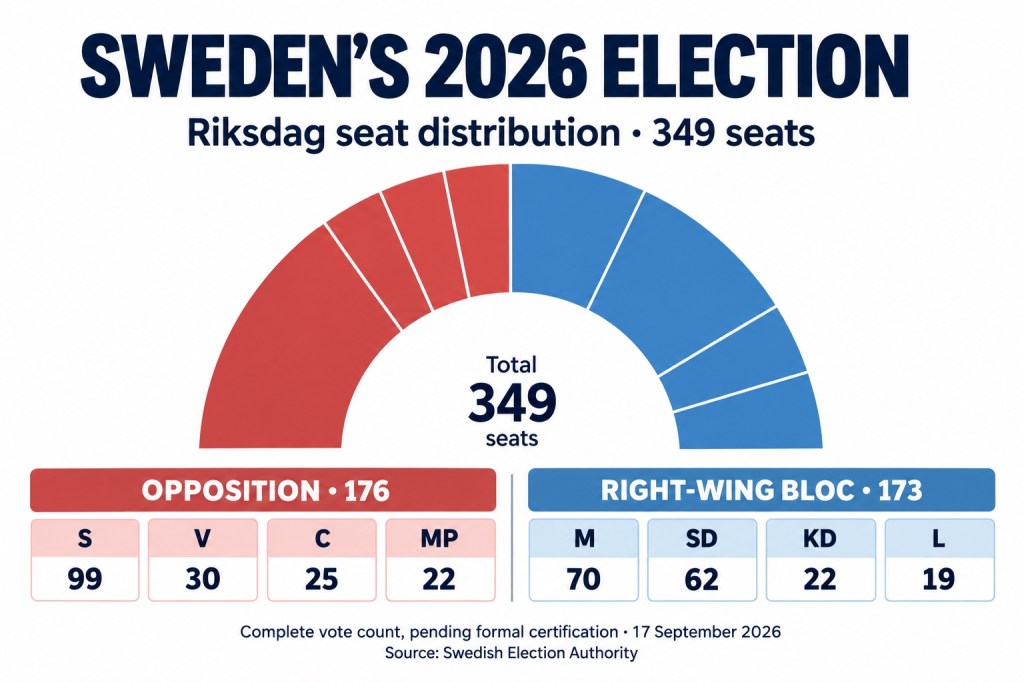
Sweden has voted for a change of government, but the result should not be mistaken for a decisive shift to the left.
The four opposition parties secured 176 of the Riksdag’s 349 seats, compared with 173 for the parties behind Ulf Kristersson’s government. The difference between the two sides was only about 42,500 votes. Kristersson has announced his resignation, leaving Social Democratic leader Magdalena Andersson in the strongest position to become prime minister. The result still awaits formal certification. Reuters
The Sweden Democrats suffered the clearest defeat. Their support fell by around three percentage points to 17.5 per cent, costing them 11 seats and pushing them behind the Moderates. According to Reuters, this was the first time the party had lost support in a Swedish parliamentary election.
Their fall appears to have been influenced by two factors. Some previous supporters may have punished the party after four years of cooperation with the government. At the same time, proposals such as banning Islamic headscarves and offering money for immigrants to leave Sweden appear to have encouraged more voters in immigrant communities to participate. In districts where at least half of residents were born abroad or had two foreign-born parents, the opposition received around 73,000 more votes than in 2022. Reuters
This does not mean Sweden has clearly rejected stricter migration policy. The Sweden Democrats lost votes, but they helped move the country’s wider political debate to the right. The Social Democrats themselves now support much tighter migration controls than they did during the refugee crisis of the previous decade. A new government is therefore unlikely to reverse every restriction introduced since 2022. Reuters
Nor should the 176 opposition seats be treated as an established governing coalition. The group includes the Social Democrats, Left Party, Greens and Centre Party. The Centre Party wants a government close to the political centre and has serious disagreements with the Left Party, particularly over economic and tax policy. Andersson may have enough seats behind her in theory, but forming a government that can pass budgets and survive important votes will be harder.
The strongest conclusion is therefore a limited one. Swedish voters removed the Kristersson government and delivered a setback to the Sweden Democrats. They did not give any party a strong mandate, and they did not necessarily vote to restore Sweden’s former approach to migration. The election changed who has the first opportunity to govern. The negotiations will determine how much policy actually changes.
 Falah Mousa